Case study · Computer vision
Blurry license plate recognition
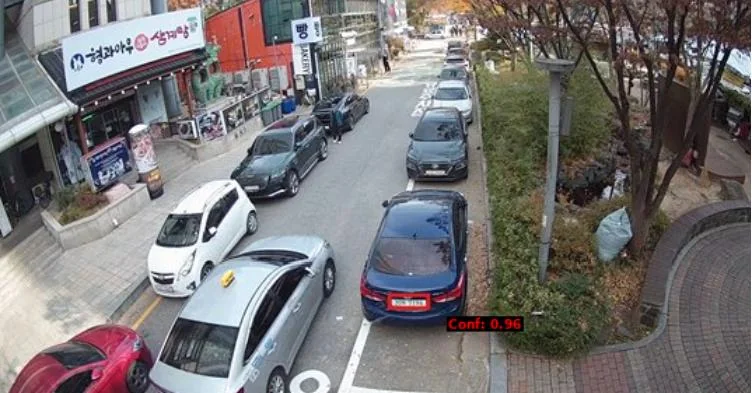
Reading Korean license plates from real street CCTV, where plates are small, blurred and seen at an angle. Detection, restoration, rectification and sequence-based OCR are chained with language-aware decoding to recover characters a single model would miss.
- >90%recognition accuracyCharacters and numbers on blurry plates
- 5pipeline stagesDetect → enhance → rectify → read → validate
- 2restoration modelsDeblurGAN-v2 for motion blur, Real-ESRGAN for resolution
The challenge
Off-the-shelf OCR works on clean, front-facing plates. Street cameras deliver the opposite: distant vehicles, motion blur, low resolution and oblique angles — and Korean plates mix Hangul syllables with digits, so a single misread character invalidates the whole result.
Our approach
Rather than ask one model to do everything, we built a pipeline in which each stage removes one failure mode: find the plate, restore it, straighten it, read it as a sequence, then validate the reading against plate grammar with a character-level language model.
Workflow
How it works, step by step.
The pipeline in 5 stages, from detect to validate. Each stage has a clear input, a clear output and a reason to exist.
- 01
Detect
YOLOv12 localizes plates in real time in the full CCTV frame.
- 02
Enhance
DeblurGAN-v2 removes motion blur; Real-ESRGAN super-resolves the crop.
- 03
Rectify
Perspective transform and normalization straighten oblique plates.
- 04
Read
ParSeq / ABINet sequence-to-sequence OCR recognizes Hangul and digits.
- 05
Validate
Beam search with plate-grammar rules and a character LM constrains the final reading.
Results
What it produced.
Stack & techniques
- YOLOv12
- DeblurGAN-v2
- Real-ESRGAN
- ParSeq
- ABINet
- Beam search
- Character language model
Delivered by members of the Saerosense founding team. Client names are withheld unless public — references are available on request.
Related service
Start a project
Have a similar problem?
Send a few lines about your data and the outcome you want. We reply within two business days with a feasibility read and a proposed scoping plan.