 Industry project
Telecom · home networking
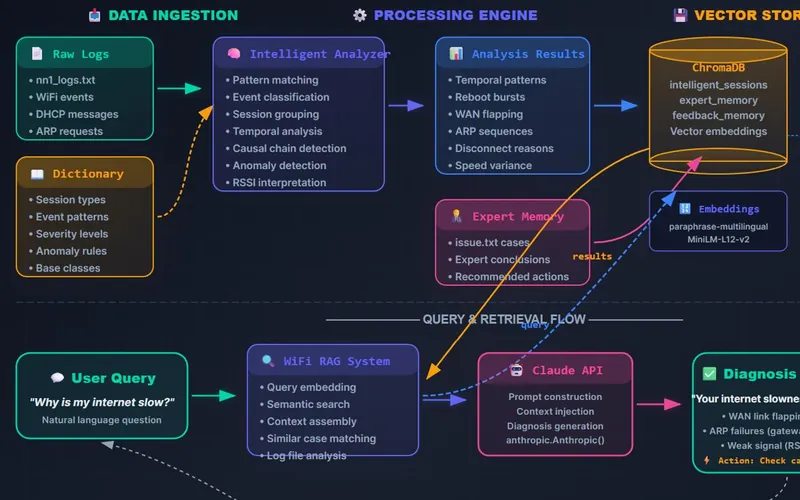
WiFi log intelligence with RAG
Vague “my internet is slow” tickets become a ranked root cause, the log lines that prove it, and the next action.
Result: 7 analysis passes · 3 vector memories
View case studyIndustry guide
Turn device logs and telemetry into diagnoses your support team can act on, and ship AI features that run on the hardware you already sell.
The problem
Customers say “the internet is slow.” The real cause is somewhere in thousands of log lines: WiFi events, DHCP, ARP, reboots, signal strength.
Diagnosis depends on a few senior engineers who know which patterns matter. Their past conclusions sit in tickets nobody can search.
Thousands to millions of devices across models and firmware versions. Outages and drift show up as noise until customers call.
What we build
Every build is scoped against a metric you can rerun yourself, and you own the code and models.
Raw device logs are parsed into sessions and causal chains, and come out as ranked, human-readable root causes with the evidence lines behind them.
RAG over device logs, manuals and past incidents, so first-line support resolves issues without escalating, and every answer shows its evidence.
Baselines per device model and firmware, with drift and outage detection across the whole fleet, plus alerts your operations team trusts.
Compact models that run offline on embedded Linux. Our WiFi-sensing model is about 230 KB and runs on an ARM device with 1 GB of RAM.
Relevant work
Our peer-reviewed work on power-line fault detection is the same problem as fleet anomaly detection: rare fault signatures hidden in noisy signals, and models that must keep working on equipment they were never trained on.
Industry projectTelecom · home networking
Vague “my internet is slow” tickets become a ranked root cause, the log lines that prove it, and the next action.
Result: 7 analysis passes · 3 vector memories
View case studySmart home · telecom
Routers detect human activity without cameras, fully on the device. A privacy-friendly feature with no cloud cost.
Result: 93.5% test accuracy · 7 activities
View case studyPower systems · transmission
A fault-detection model that keeps working on power lines it was never trained on. Published in IEEE Access.
Result: 90.5% on unseen lines (GRU: 80.7%)
View case studyEngagement options
Scope first, build only if the numbers say it’s worth it, and add Operate if you’d rather we run it.
Fixed price · 1 to 2 weeks
We study your data and workflow, agree on the metric that defines success, and give you a fixed quote for the build.
Fixed price · prototype in 2 to 6 weeks, then production
A working prototype on your real data, then hardening, deployment and handover to your team.
Monthly · cancel with 30 days’ notice
We keep your system accurate, current and cheap to run, so your team doesn’t have to.
Common questions
No, it’s the normal starting point. Parsing and normalizing mixed log formats is treated as real engineering work in the engagement, not an assumption we skip.
No. Diagnosis pipelines can run in your VPC or on-premise with open-weight models, designed for carrier-grade privacy expectations.
Yes, within honest limits. We usually split the system into a fast streaming layer for detection and a slower reasoning layer for diagnosis, so alerts are timely and explanations are thorough.
Start a project
Two or three sentences about the data you have and the outcome you want is enough. We reply within 1 business day with an honest read on feasibility. No slide deck needed.