Case study · Network & telemetry AI
Pattern-recognition auto-reclosing with Bi-LSTM
A deep-learning auto-reclosing scheme that reads the faulty-phase voltage as a sequence. A bidirectional LSTM predicts the secondary-arc extinction interval and whether a fault is temporary or permanent — and keeps working on transmission-line models it never saw in training.
Published in IEEE Access — “Pattern Recognition Based Auto-Reclosing Scheme Using Bi-Directional Long Short-Term Memory Network”
- 100%test accuracyTemporary vs permanent, noise-free test set
- 95.1%under heavy noisePermanent-fault accuracy at SNR 10
- 90.5%on unseen line modelsVersus 80.7% for GRU and 70.4% for U-LSTM
The challenge
Arc-extinction timing depends on line parameters, compensation and arc resistance, so a scheme tuned on one line model often fails on another. Field measurements are noisy, too.
Our approach
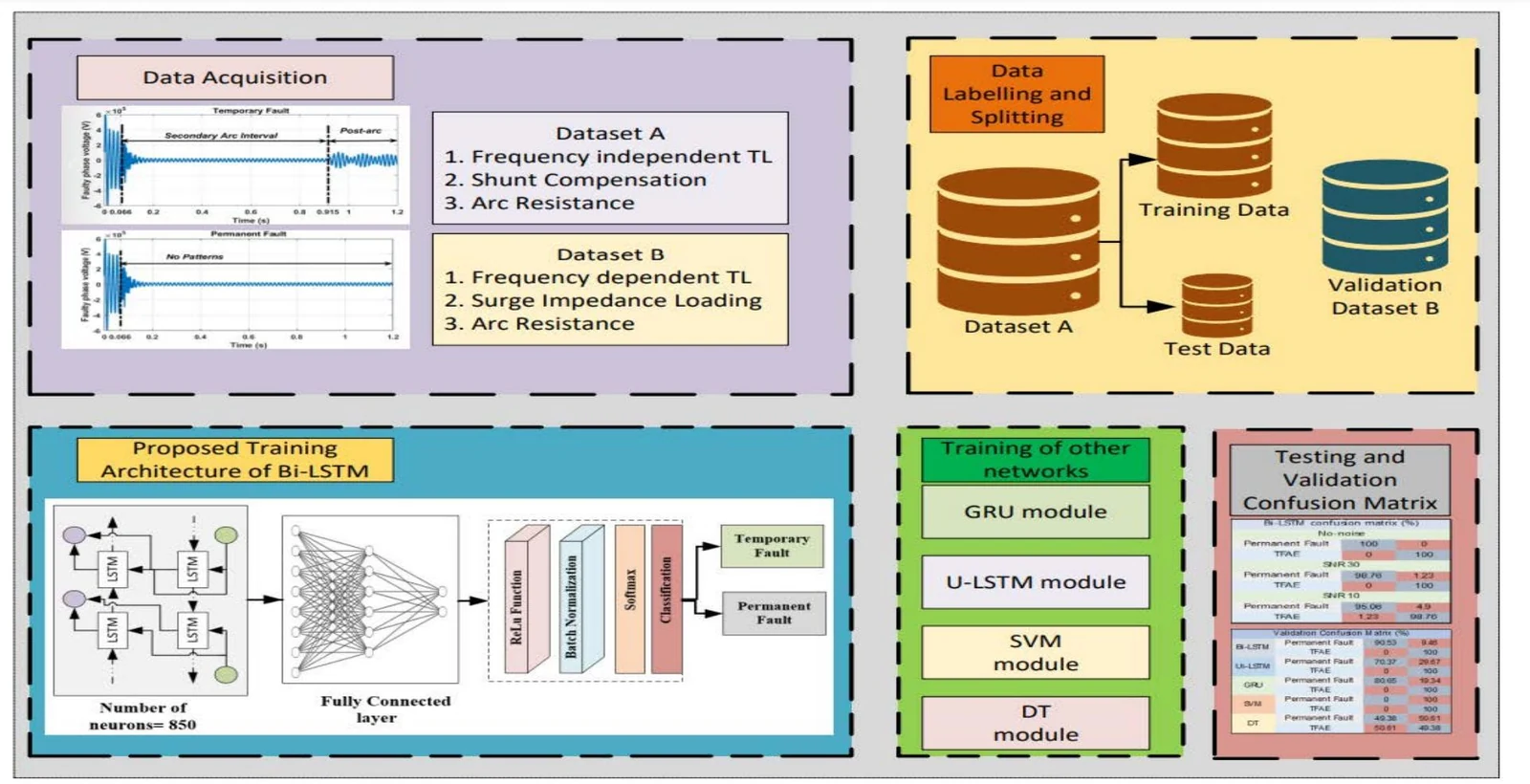
Two datasets were built from different line models: Dataset A (frequency-independent lines, shunt compensation, arc resistance) for training and testing, and Dataset B (frequency-dependent lines, surge-impedance loading, arc resistance) held out entirely for validation. A Bi-LSTM with 850 neurons was benchmarked against GRU, uni-directional LSTM, SVM and decision-tree models, with and without added noise.
Workflow
How it works, step by step.
The pipeline in 5 stages, from acquire to decide. Each stage has a clear input, a clear output and a reason to exist.
- 01
Acquire
Faulty-phase voltage for temporary and permanent faults across varied line models.
- 02
Split
Dataset A for training and testing; Dataset B held out for validation.
- 03
Train
Bi-LSTM (850 neurons) → fully connected → ReLU → batch norm → softmax.
- 04
Benchmark
Compared with GRU, U-LSTM, SVM and decision tree, at SNR 30 and SNR 10.
- 05
Decide
Predicted fault type and arc-extinction interval drive the reclosing decision.
Results
What it produced.
Validation on unseen line models (Dataset B) · accuracy by fault type
Only the Bi-LSTM keeps recognizing permanent faults reliably on line models it never saw in training; SVM labels every fault as temporary.
Noise robustness · Bi-LSTM on the test set
| Condition | Permanent fault | Temporary fault |
|---|---|---|
| No noise | 100% | 100% |
| SNR 30 | 98.76% | 100% |
| SNR 10 | 95.06% | 98.76% |
Stack & techniques
- Bi-LSTM
- GRU
- LSTM
- SVM
- Decision tree
- Power-system signal processing
Delivered by members of the Saerosense founding team. Client names are withheld unless public — references are available on request.
Related service
Start a project
Have a similar problem?
Send a few lines about your data and the outcome you want. We reply within two business days with a feasibility read and a proposed scoping plan.