Case study · Network & telemetry AI
Auto-reclosing with particle filter & CNN
A single-phase auto-reclosing scheme for shunt- and non-shunt-compensated transmission lines. A particle filter estimates voltage harmonics, two engineered indices capture arc behavior and fault type, and a CNN decides whether — and when — breakers can safely reclose.
Published in IEEE Transactions on Power Delivery
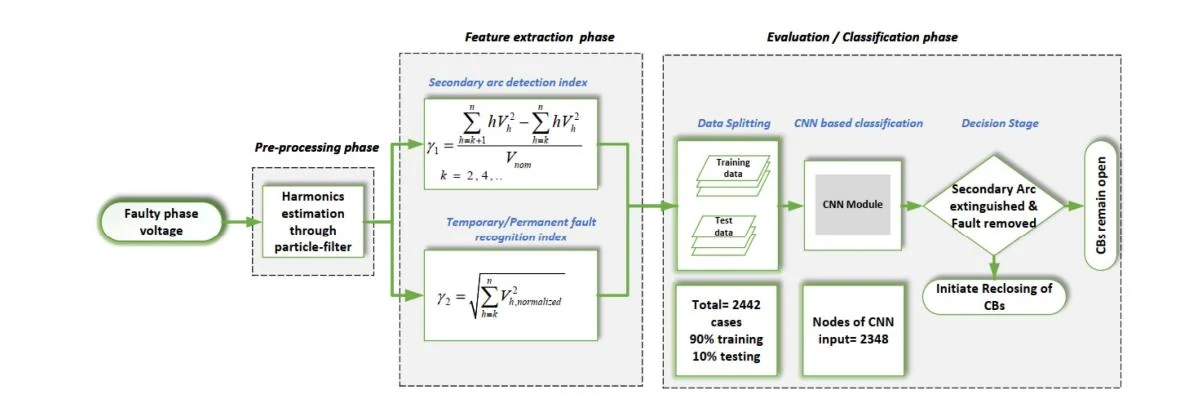
- 2,442fault cases90% training · 10% testing
- 2engineered indicesSecondary-arc detection γ₁ and fault recognition γ₂
- 3detectors comparedCNN, DNN and SVM classifiers
The challenge
After a single-phase fault, breakers must reclose quickly to keep the line in service — but reclosing into a permanent fault, or before the secondary arc has extinguished, damages equipment and destabilizes the grid. Fixed dead-times are either too slow or unsafe, especially on compensated lines.
Our approach
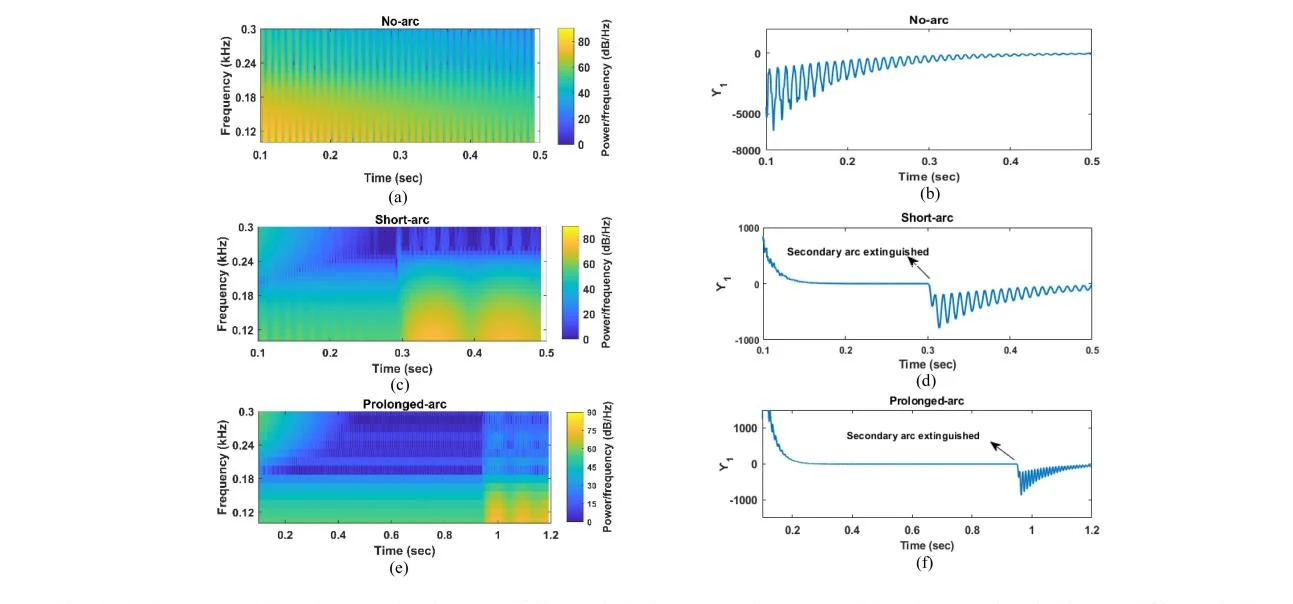
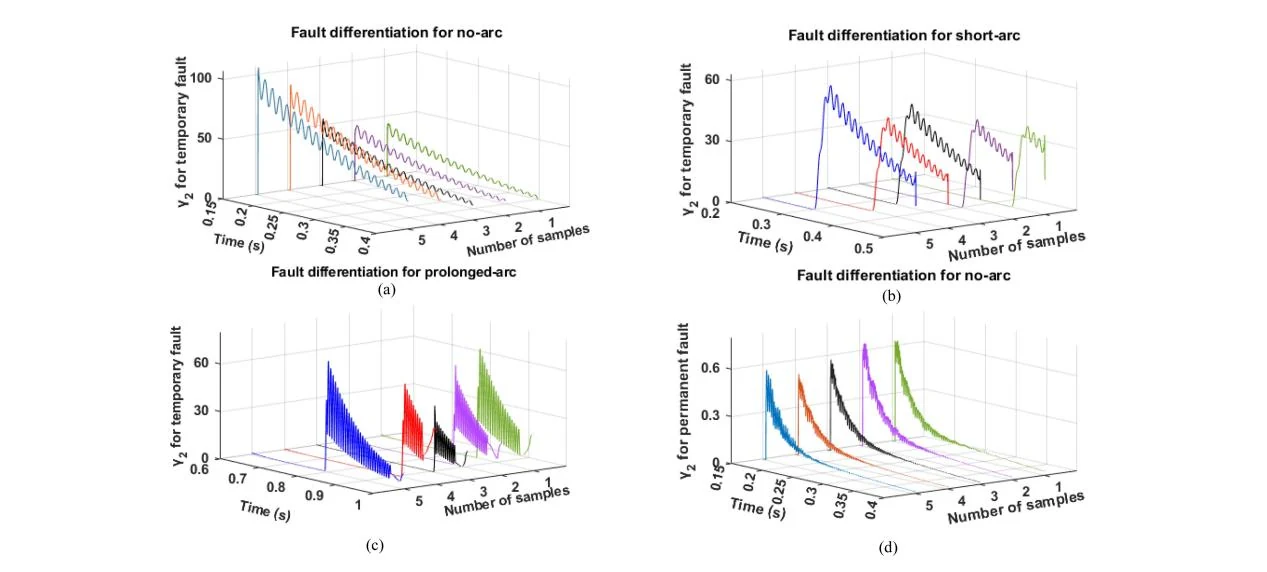
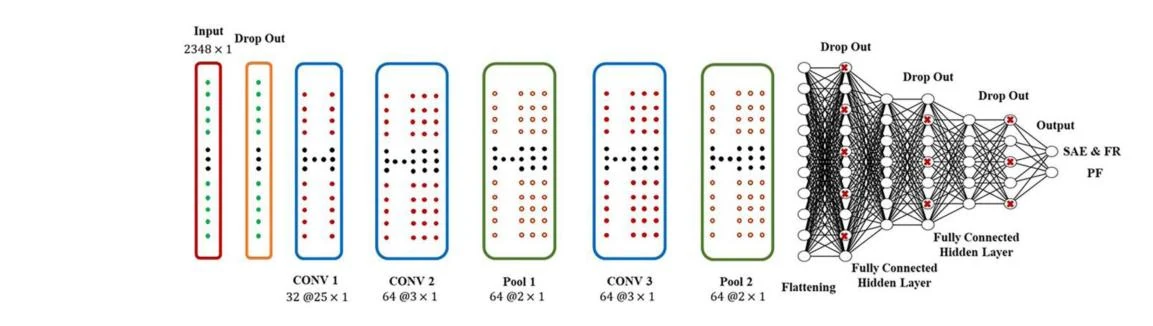
The faulty-phase voltage is decomposed into harmonics with a particle filter. Two indices are computed: γ₁ tracks secondary-arc extinction from harmonic energy, and γ₂ separates temporary from permanent faults. A CNN classifies these features, and breakers reclose only when the arc is extinguished and the fault is temporary.
Workflow
How it works, step by step.
The pipeline in 5 stages, from measure to decide. Each stage has a clear input, a clear output and a reason to exist.
- 01
Measure
Faulty-phase voltage captured at the line terminal.
- 02
Estimate
A particle filter estimates the harmonic components.
- 03
Extract
Secondary-arc index γ₁ and temporary/permanent fault index γ₂.
- 04
Classify
1-D CNN with 2,348 input nodes trained on 2,442 cases; compared with DNN and SVM.
- 05
Decide
Arc extinguished and fault removed → reclose. Otherwise breakers stay open.
Results
What it produced.
Stack & techniques
- Particle filter
- Harmonic estimation
- CNN
- DNN
- SVM
- Power-system signal processing
Delivered by members of the Saerosense founding team. Client names are withheld unless public — references are available on request.
Related service
Start a project
Have a similar problem?
Send a few lines about your data and the outcome you want. We reply within two business days with a feasibility read and a proposed scoping plan.