Case study · Computer vision
Stereo visual-inertial odometry (MSCKF)
High-precision localization for robots, drones and AR/VR devices: a stereo Multi-State Constraint Kalman Filter fuses camera and inertial measurements to estimate motion in real time while keeping drift in check.
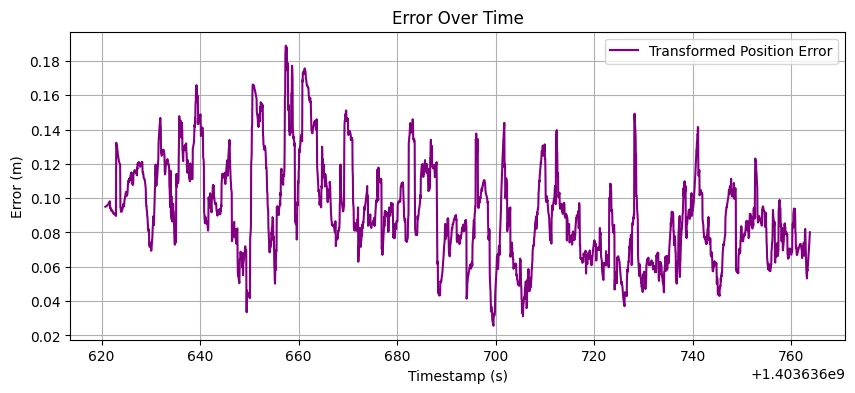
- <0.2 mposition errorThroughout the evaluated sequence
- ≈0.1 mtypical errorOver a run of roughly 140 seconds
- Real-timeestimationEfficient enough for robots and embedded platforms
The challenge
Visual odometry drifts: small errors in each frame compound into large position errors, and cameras alone struggle with fast motion and low texture. Robots, drones and AR headsets need localization that stays accurate without GPS.
Our approach
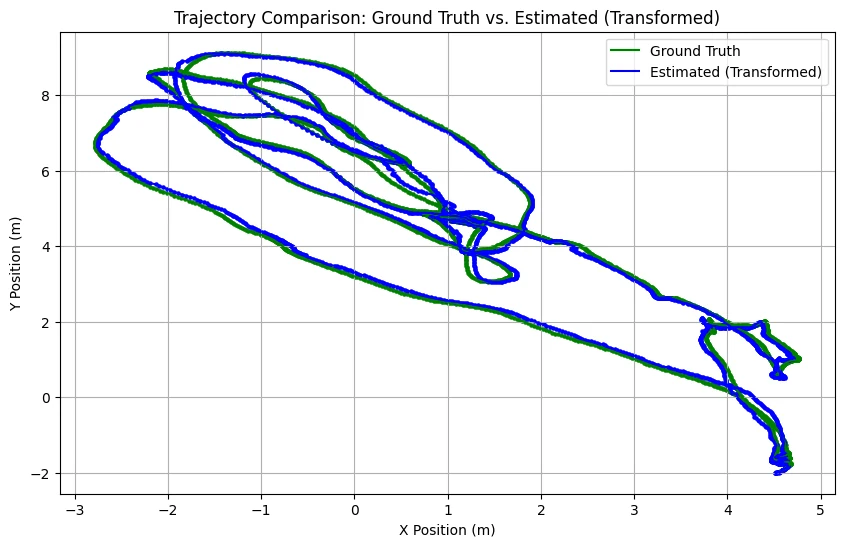
Stereo-MSCKF tightly couples stereo feature observations with IMU propagation. Instead of keeping every landmark in the state, it constrains a sliding window of camera poses — accurate, and efficient enough for real-time use. The estimate was aligned to ground truth and evaluated over the full trajectory.
Workflow
How it works, step by step.
The pipeline in 5 stages, from sense to evaluate. Each stage has a clear input, a clear output and a reason to exist.
- 01
Sense
Synchronized stereo images and IMU measurements.
- 02
Propagate
IMU readings propagate the state between camera frames.
- 03
Track
Visual features are tracked across stereo frames.
- 04
Update
Multi-state constraints from tracked features correct a sliding window of poses.
- 05
Evaluate
The estimated trajectory is aligned and compared with ground truth.
Results
What it produced.
Stack & techniques
- Stereo-MSCKF
- Kalman filtering
- Visual-inertial fusion
- Python
Delivered by members of the Saerosense founding team. Client names are withheld unless public — references are available on request.
Related service
Start a project
Have a similar problem?
Send a few lines about your data and the outcome you want. We reply within two business days with a feasibility read and a proposed scoping plan.